
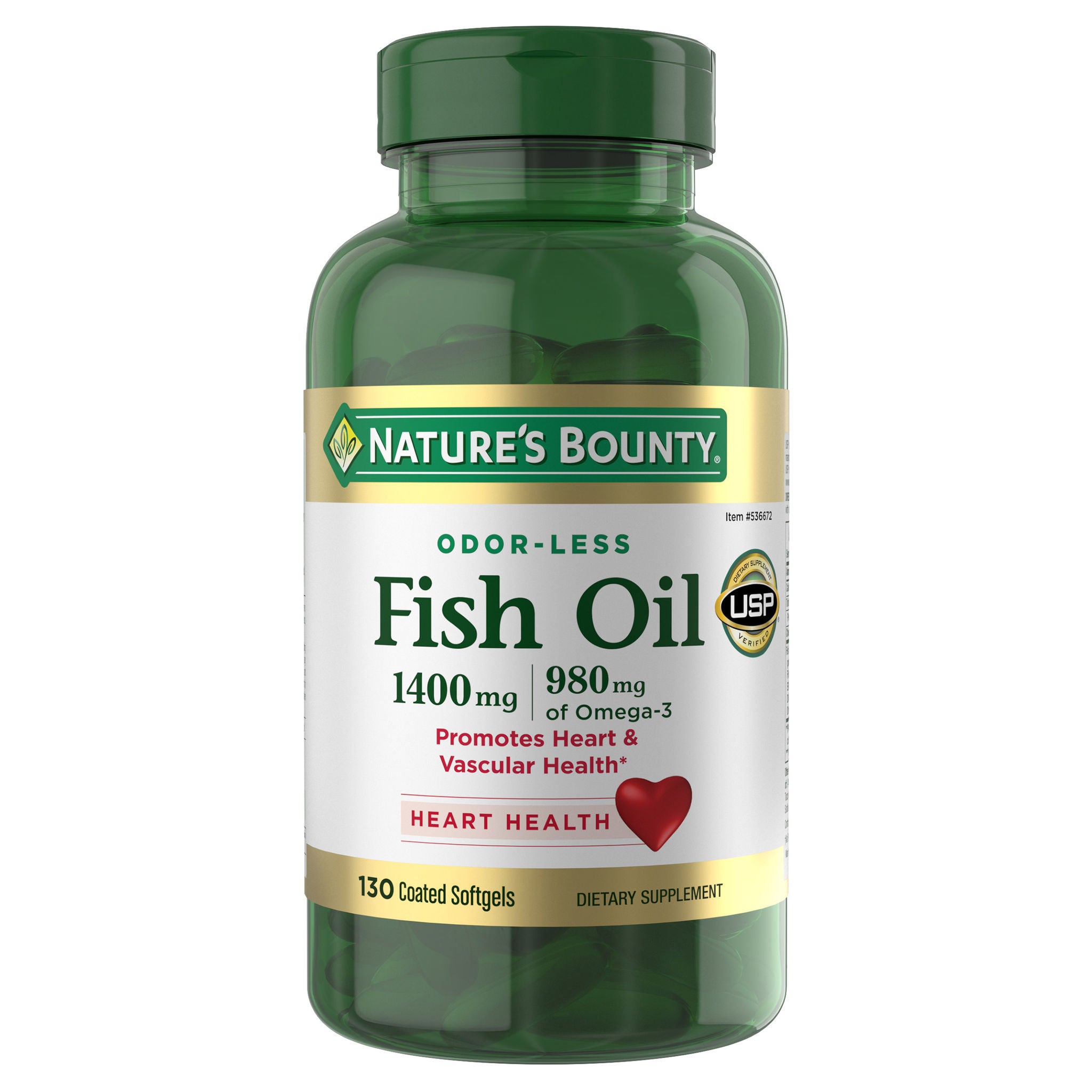
Nature's Bounty Fish Oil 1400 mg, 130 Coated Softgels
- CalShop ID
- 20875
- Type
- Omega & Fish Oil
- Form
- Softgel
Item Info
- • 1400 mg of Fish Oil Provides 980 mg of Omega-3
- • Promotes Heart & Vascular Health†
- • Beneficial for Joint Health†
- • Odorless, Coated to Minimize Fish Burps
- • USP Verified*
Promotes Heart and Vascular Health nature's Bounty maximum strength fish oil Nature’s Bounty® Fish Oil 1400 mg provides the important omega-3 fatty acids, EPA and DHA that help support the health of your cardiovascular system.† Omega-3 fatty acids are considered “good” fats since they are important for cellular, heart and metabolic health.† Our formula contains a high concentration of 70% Omega-3 fatty acids, providing 980 mg of Omega-3 fatty acids from 1400 mg of fish oil. While regular strength fish oils typically contain 300 mg of Omega-3s from 1000 mg of fish oil, our formula undergoes additional purification steps to concentrate these essential fatty acids and remove unwanted compounds, such as mercury. Promotes heart health, beneficial for joint health, order-less, coated to minimize fish burps. Oner perday, 900 mg EPA and DHA, 70 percent concertation of Omega-3. Benefits of Fish Oil heart health, metabolic health, cellular health, joint health Supportive but not conclusive research shows that the consumption of EPA and DHA omega-3 fatty acids may reduce the risk of coronary heart disease. One serving of Nature’s Bounty® Fish Oil provides 900 grams of EPA and DHA omega-3 fatty acids. It is estimated that more than 1 in 3 American adults have at least one type of cardiovascular disease, such as, high blood pressure, coronary heart disease or stroke.4 There are many risk factors for cardiovascular disease which include smoking, high cholesterol, a sedentar or inactive lifestyle, and poor nutrition.4 Even though Fish Oil is primarily known for heart health, its benefits do not stop there.† Omega-3 fatty acids are some of the most important fatty acids you need for cellular health.† They play a key structural role in the membrane of every cell in the body and are essential for normal cell growth.† They are also some of the most important fatty acids you need for metabolic health and are even essential for normal skin function.† Omega-3 fatty acids are also beneficial for joint health and help maintain triglyceride levels already within a
normal range.† Why supplement? The Dietary Guidelines for Americans recommends adults consume 8 ounces of a variety of seafood each week for heart health. This would provide an average of 250 mg of EPA and DHA per day. The best dietary sources of EPA and DHA include salmon, anchovies, herring, shad, sardines, Pacific oysters, trout, and Atlantic and Pacific mackerel. However, the average intakes of seafood for males and females in all age groups are below the recommended amounts.5 Furthermore, many popular types of seafood such as tilapia, catfish, and shrimp, do not contribute significant amounts of omega-3s to the diet. EPA and DHA are not considered to be essential fatty acids because they can be synthesized from another omega-3 fatty acid, ALA. Essential nutrients are those that cannot be made by the body and must be obtained from dietary sources. However, ALA is an essential fatty acid so if dietary intake is not adequate, EPA and DHA can become conditionally essential. Furthermore, the conversion of ALA to EPA and DHA in the body is poor so it is recommended that EPA and DHA are obtained from additional sources such as dietary supplements.2 Salmon, shad, sardines, mackerel, anchovies, trout, oyester, herring how much should I take? The American Heart Association recommends consuming between 500 to 1800 mg of EPA and DHA per day for overall heart health.† When reading labels, the supplement facts box will list the total amount of fish oil as well as the amounts of EPA and DHA, which are sometimes grouped together as total Omega-3s. The most important factor to consider is the amount of Omega-3. The maximum amount of fish oil you should consume from supplements each day depends on how much fatty fish is eaten in your diet. In general, it is recommended not to consume more than 2 grams of Omega-3s from fish per day. The 2015-2929 Dietary Guidelines recommended consuming 8 oz, of a variety of seafood per week for optimal heart health. This provides an average of 250 mg EPA and DPA per day. the importance of purity We all know the old adage, you are what you eat. While fish is a great source of protein, as well as micronutrients and good fats, some species can be associated with high levels of mercury. Swordfish and Marlin, for example, should be avoided by pregnant and lactating women.6 However, DHA is an important nutrient for pregnant and nursing women since it supports fetal brain and eye development and maternal health.† Nature’s Bounty® Fish Oil goes through a special purification process of selective heating and cooling to eliminate mercury. The end result is a pure fish oil you can feel good about taking every day!. cooling, heating. mercury. fish oil. Supplement Facts supplement facts image †These statements have not been evaluated by the Food and Drug Administration. This product is not intended to diagnose, treat, cure or prevent any disease. References 1. IOM. 2002. Dietary reference intakes for energy, carbohydrate, fiber, fat, fatty acids, cholesterol, protein and amino acids. Washington,
DC: The National Academies Press. 2. https://lpi.oregonstate.edu/mic/other-nutrients/essential-fatty-acids#metabolism-bioavailability 3. https://www.heart.org/en/healthy-living/healthy-eating/eat-smart/fats/saturated-fats?s=q%253Dsaturated%252520fat%2526sort%253
Drelevancy 4. American Heart Association. Circulation. 2011; 123:e18-e209. 5. U.S. Department of Health and Human Services and U.S. Department of Agriculture. 2015-2020 Dietary Guidelines for Americans. 8th
Edition. December 2015. 6. www.FDA.gov/fishadvice References: USP verified Dietary Supplement USP verified This item is verified by the United States Pharmacopeia (USP) which is an independent, scientific, non-profit organization that sets strict quality and purity standards for dietary supplements manufactured and distributed worldwide.